 Raised Bed Builder
4x8 raised bed plans: cut list, materials and soil
Quick answer: to build a 4 x 8 ft raised bed 11 in tall, buy six 8 ft 2x6 boards, one 8 ft 4x4 and about 40 exterior screws (3 in). Use four boards whole for the long sides, cut two boards into four 3 ft 9 in end pieces, and cut the 4x4 into six 11 in posts. Fill it with about 26.2 cubic feet of soil.
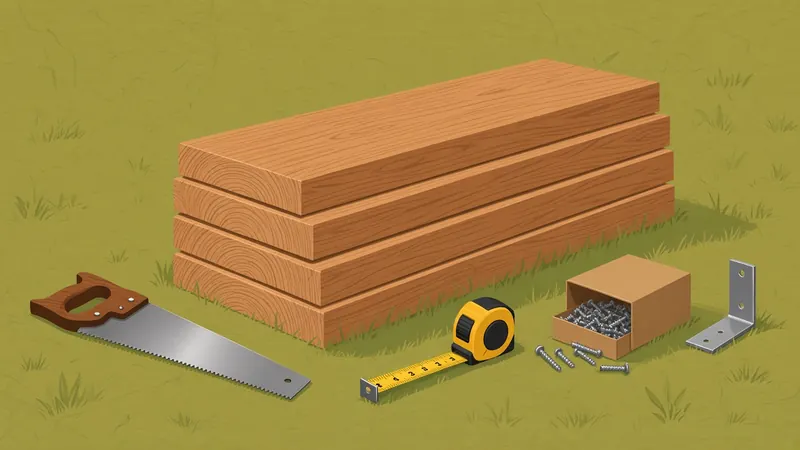
Cut list for a 4 x 8 ft bed, 11 in tall
This is the planner's output for one 4 x 8 ft bed (outside size) built two 2x6 boards high from cedar, with 4x4 corner posts and 8 ft boards.
| Piece | How many | Length | Cut from |
|---|---|---|---|
| Long side boards (2x6) | 4 | 8 ft (no cut) | 4 x 8 ft boards, used whole |
| End boards (2x6), fit between the long sides | 4 | 3 ft 9 in (45 in) | 2 x 8 ft boards, two pieces from each |
| Posts (4x4): 4 corners and 2 mid-wall | 6 | 11 in | 1 x 8 ft 4x4 |
| Exterior screws, 3 in, coated or stainless | 40 | 2 per board end, 1 box of about 50 |
Each board you cut into end pieces leaves a short offcut, after allowing 1/8 in for each saw cut. If your store has 12 ft boards, four of them cut into 8 ft plus 3 ft 9 in also works, and at our default prices it costs the same.
Other heights and board sizes
Taller walls cost more in lumber and soil, but are easier on your back. Here is what the planner gives for the same 4 x 8 ft bed with different boards. Click a row to open that plan.
| Boards | Height | Boards to buy | 4x4 posts | 3 in screws | Soil | Lumber, posts and screws |
|---|---|---|---|---|---|---|
| 2x6, two boards high | 11 in | 6 x 8 ft | 6 at 11 in | 40 | 26.2 cu ft | about $174 |
| 2x6, three boards high | 16 1/2 in | 9 x 8 ft | 6 at 16 1/2 in | 60 | 40.6 cu ft | about $282 |
| 2x8, two boards high | 14 1/2 in | 6 x 8 ft | 6 at 14 1/2 in | 40 | 35.3 cu ft | about $234 |
| 2x10, one board high | 9 1/4 in | 3 x 8 ft | 6 at 9 1/4 in | 30 | 21.6 cu ft | about $168 |
| 2x12, one board high | 11 1/4 in | 3 x 8 ft | 6 at 11 1/4 in | 30 | 26.8 cu ft | about $207 |
Costs use the planner's default cedar prices, which are typical US big-box prices and vary by region and season. Wide 2x10 and 2x12 boards get three screws per board end.
Which wood?
Cedar and redwood resist rot on their own and often last 10 years or more, depending on climate. Pressure-treated pine sold for homes since 2004 uses copper-based preservatives (ACQ, CA or MCA), and many extension services consider it acceptable for food gardens. University of Maryland Extension notes that research at Oregon State University found MCA-treated lumber raised soil copper by a minor amount and only within 1 in of the bed edge, with no increase in copper in the plants grown. Buy boards rated for ground contact, and line the inside walls if you would rather keep soil off the wood. Treated wood is not allowed in certified organic growing. Avoid old CCA lumber and railroad ties. Untreated pine is cheapest but may need replacing in 3 to 5 years.
| Wood | Estimated cost |
|---|---|
| Cedar | about $174 |
| Pressure-treated pine | about $86 |
| Untreated pine | about $72 |
How to build it
- Cut the boards. Leave four of the 8 ft boards whole for the long sides. Cut the other two in half to get four end boards of 3 ft 9 in (45 in) each. Cut the 4x4 into six posts, 11 in long. Wear a dust mask when cutting, and seal cut ends of treated boards with an end-cut preservative.
- Build the end walls. Stand two posts on a flat surface and lay two 3 ft 9 in end boards across them, one above the other, flush with the post tops and with the post sides lined up with the board ends. Drive two 3 in exterior screws through each board end into the post. Pre-drill near board ends to avoid splits. Build the second end wall the same way.
- Add the long walls. Set the end walls 8 ft apart, posts facing in. Screw the 8 ft long boards to the posts so their ends cover the end boards, two screws per board end. The bed now measures exactly 4 x 8 ft outside.
- Add the mid-wall posts. Screw one post to the middle of each long wall, 4 ft from each end, two screws per board. These stop the long walls bowing out once the bed is full of wet soil.
- Square it up. Measure both diagonals, corner to corner. Nudge the frame until they match (about 107 5/16 in each for a 4 x 8 ft bed).
- Protect the bottom and fill. If gophers or voles are a problem, staple 1/2 in hardware cloth across the bottom and 6 in up the walls. On grass, a layer of plain cardboard smothers the turf. Fill with your soil mix, water well, and top up to about 1 in below the rim after it settles.
Shopping list and cost
Here is the planner's full estimate for the cedar bed, 11 in tall, with bulk soil, hardware cloth and drip irrigation. Leave out what you do not need.
| Lumber | $132 |
| 4x4 posts | $30 |
| Screws | $12 |
| Soil (bulk delivery) | $120 |
| Hardware cloth | $60 |
| Drip irrigation | $35.50 |
| Estimated total | $389.50 |
- Soil: 26.2 cubic feet (0.97 cubic yards). At our default prices one cubic yard of bulk delivery came in under 19 bags of 1.5 cu ft. Details in our soil chart.
- Hardware cloth: 15 ft of 4 ft wide 1/2 in galvanized cloth, cut in strips that run 6 in up each wall and overlap 6 in. That is one 4 x 25 ft roll.
- Drip line: 35 ft of drip line with 12 in emitter spacing, in rows about 12 in apart, plus 25 ft of 1/2 in supply tubing, a pressure regulator and a filter. With 0.5 gallon per hour emitters, about 1 hour a week gives the bed about 1 in of water (about 18 gallons).
Where to put it
Most vegetables need 6 to 8 hours of direct sun, so choose a sunny, level spot near a hose. A 4 ft width lets you reach the middle from either side. University of Illinois Extension recommends beds no more than 4 ft wide if you can reach them from both sides, and 3 ft if you can only reach from one side. Leave room for a path you can kneel on.
Questions
How many boards do I need for a 4x8 raised bed?
For a bed two 2x6 boards high (11 in), buy six 8 ft 2x6 boards: four stay whole for the long sides and two are cut into four 3 ft 9 in end boards. A bed three boards high (16 1/2 in) takes nine. With 2x10 or 2x12 boards one board high, you need three.
Why are the end boards 3 ft 9 in, not 4 ft?
The end boards fit between the long boards. Each long board is 1 1/2 in thick, so the end boards are 3 in shorter than the 4 ft outside width. That keeps the outside of the bed at exactly 4 x 8 ft.
How much soil does a 4x8 raised bed hold?
At 11 in tall, filled to 1 in below the rim with 10% extra for settling, buy about 26.2 cubic feet (0.97 cubic yards). At 16 1/2 in tall, buy about 40.6 cubic feet. See our soil chart for other sizes.
How much does it cost to build a 4x8 raised bed?
At our default prices, the cedar lumber, posts and screws for an 11 in tall bed come to about $174, or about $86 with pressure-treated pine. With bulk soil, hardware cloth and drip irrigation, the cedar bed is about $389.50 in total. Prices vary by region and season, so edit them in the planner.
These numbers come straight from our planner, which we test on more than 30,000 bed designs. They are estimates for planning. Lumber is not always true to size and prices change, so measure twice and check prices at your store. Spot a problem? Report it.